
Canine Tumor Drug Sensitivity Testing — 3D Organoid Platform
Canine tumor drug sensitivity testing using 3D tumor organoids: 48 chemo/targeted drugs tested on a "stand-in" tumor, results in about 10 days, four-tier readout to guide drug choice. Includes chemo, targeted drugs, and PD-1/PD-L1 antibodies. In vitro results for veterinary reference.
Time is the most expensive cost in cancer care. Drug sensitivity testing lets an "avatar" take the trial-and-error, turning blind trials into choices.
Canine tumor drug sensitivity testing grows a "3D tumor organoid" from tumor tissue collected during surgery — a miniature model that preserves the real characteristics of that dog's tumor — then tests 48 chemo/targeted drugs on this "stand-in" and delivers a personalized drug map in about 10 days, giving your veterinarian data to guide drug selection. Start with the most expensive thing in cancer care: time. Traditionally, chemo and targeted drugs are chosen largely by trial — and drug sensitivity testing means your pet doesn't have to be the trial subject.

What this service does
Grow the tumor tissue into a "3D avatar" that keeps this tumor's real characteristics, then test 48 drugs on it one by one in the lab — sensitive and resistant at a glance. Your pet never becomes a trial mouse; time goes to what works.
- 48 drugs: chemo and targeted drugs tested in parallel, combination regimens supported
- ~10-day report: a personalized "drug map" with a four-tier readout
- Dogs and cats: PD-1/PD-L1 immune drugs can be tested too
Why it matters
Trial-and-error costs time, and tumors don't wait
A regimen takes 1–2 months to evaluate; if it fails, switch and wait again. Advanced tumors progress day by day — every week of guessing is unaffordable
Leave the trial-and-error to the stand-in
The 3D organoid preserves this tumor's real characteristics; sensitivity measured on the "avatar" beats guessing — your pet never becomes a trial mouse
Dogs and cats, broad coverage
Lymphoma, mast cell tumor, sarcoma, melanoma, and other common canine/feline hematologic and solid tumors
Immune drugs can be rehearsed too
PD-1/PD-L1 antibodies and cell therapies can be evaluated — every route of the arsenal rehearsed on the avatar first
Blind trial vs. avatar trial
Your pet is the test subject
- One regimen takes 1–2 months to evaluate, then switch and wait again
- Meanwhile the tumor keeps growing
- Side effects land on your pet first
The stand-in tests first
- 48 drugs tested in parallel on 3D organoids
- Report in ~10 days — no waiting through round after round
- Sensitive and resistant at a glance — drug choices backed by data
How it works
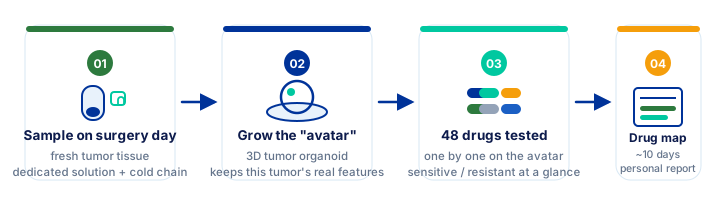
Platform capabilities:
| Item | Details |
|---|---|
| Input | Tumor tissue from surgery, grown as 3D organoid models |
| Drug coverage | 48 chemo/targeted drugs, plus PD-1/PD-L1 antibodies (immune cell co-culture); combination regimens supported |
| Report time | ~10 days (2–5 days organoid culture + ~5 days assay) |
| Readout | Four tiers: sensitive (>80% kill) / partially sensitive (50–80%) / partially resistant (30–50%) / resistant (<30%) |
How to read the report — a personalized "drug map" in four tiers:
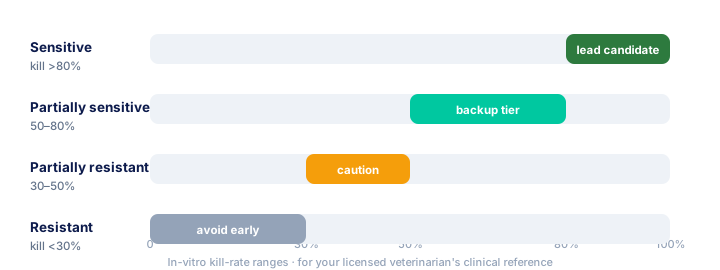
Lead candidates
First-line drugs to try first — time goes to the most likely effective plan
Backup tier
Direct switch options when first-line drugs fail — no need to re-try
Caution
Uncertain efficacy — weighed by the veterinarian with clinical context
Avoid early
No wasted cost, no needless side effects on your pet
Sample requirements:
| Sample type | Requirements |
|---|---|
| Surgical tumor tissue | ~0.5–1g of tumor cell–rich portion; place immediately into the dedicated preservation solution; ship cold-chain within 48h at 4°C |
| Fine-needle aspirate | 5mm×1mm, 3–5 passes (cell content assessed) |
| Thoracic/abdominal fluid | 5–10ml, cold-chain within 48h |
| Peripheral blood (PD-1/PD-L1 assay or blood tumors) | 3–10ml, heparin tube; PD-1/PD-L1 assay requires tumor + blood dual samples |
Trust in the numbers
- ~95% platform assay success rate: most submitted samples successfully grow organoids and complete the full assay
- ~86% concordance with clinical outcomes in historical data (in vitro results differ from the in vivo environment; the report supports the licensed veterinarian's clinical judgment and is not a prescription)
Case study
"Rousong's" drug map: one dog completed the 48-drug sensitivity panel; the report showed 3 drugs "sensitive" (mitoxantrone, dactinomycin, doxorubicin) and 8 "partially sensitive" — the attending veterinarian went straight to the "sensitive" list for the first round, avoiding blind trial after blind trial. In vitro results differ from the in vivo environment; the report is for the licensed veterinarian's clinical reference.
More real cases are being added continuously.
Sequencing says "possible"; sensitivity testing measures "effective"
Sequencing reads mutations ("what might work"); drug sensitivity testing measures actual efficacy ("what does work") — complementary, not conflicting:
- Pathology: confirms "what cancer it is" (morphology layer)
- Gene sequencing: finds mutations and targets — "which drug directions exist" (molecular layer, learn about sequencing)
- Drug sensitivity testing: measures killing rates of 48 drugs — "which drugs really work" (cellular layer)
One more diagnostic dimension, one more chance of a matched treatment.
One sample, two paths
The same fresh tumor tissue collected on surgery day can go to RNA sequencing (molecular layer — mutations and neoantigen clues) and drug sensitivity testing (cellular layer — actual efficacy) in parallel — one sample, two paths, faster and more complete decisions. Note: the two paths require different dedicated preservation solutions — contact the team in advance (WeChat petcura) to prepare.
PD-1/PD-L1 can also be tested
The platform can evaluate not only chemo and targeted drugs but also PD-1/PD-L1 antibodies via immune cell co-culture — every route of the treatment arsenal can be "rehearsed" on the avatar first. On the immune layer there is another path: personalized mRNA immunotherapy (the "wanted poster" route), learn about mRNA immunotherapy.
How to participate
Pet owners: collect tumor tissue on surgery day (contact the team in advance for the dedicated preservation solution) → cold-chain shipping → drug map in ~10 days → discuss the regimen with your veterinarian. Add us on WeChat petcura for shipping arrangements.
Veterinarians: case assessment → sample preparation (preservation solution delivered in advance) → cold-chain shipping → assay → report interpretation support. Labs cover Beijing, Shanghai, Guangdong, Chengdu, Suzhou, Hefei (drug sensitivity business scope). → Contact us
FAQ
Sample preparation, readout, cost? → Drug sensitivity FAQ
Learn more: Sequencing & targeted drug guidance · Cancer × Gene × Drug Reference · Drug sensitivity FAQ · Contact