Surgery-Day Sampling — Keeping the Right to Choose Future Treatment
Freezing is not a treatment decision today — it keeps the right to choose tomorrow
By the time pathology results arrive, the window is already closed. Prepare in advance so every option stays on the table.
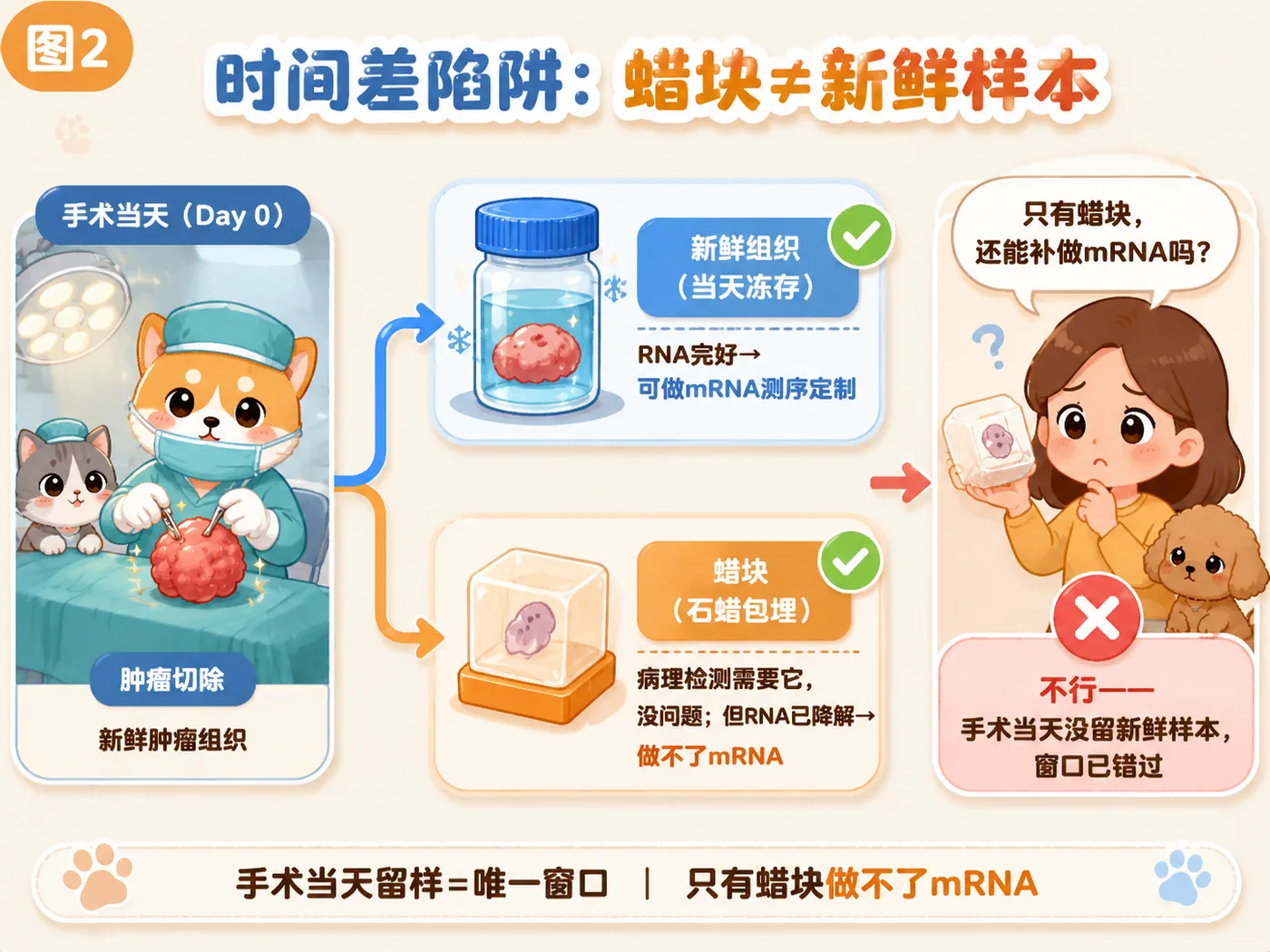
Surgery day is the only time fresh tumor tissue can be collected — and fresh tissue is the shared starting point of personalized precision treatment (gene sequencing, drug sensitivity testing, and mRNA immunotherapy). By the time pathology results arrive (usually 3–7 days later), the surgery-day sampling window is already gone. So even before pathology results are ready, properly preserve a fresh tumor sample on surgery day — not a treatment decision today, but the right to choose tomorrow.
Why it must be surgery day
| Time point | What you get | What it enables |
|---|---|---|
| Surgery day | Fresh tumor tissue (living tissue, intact RNA) | RNA sequencing, organoid culture, drug sensitivity testing, mRNA customization — the prerequisite of every personalized path |
| After pathology (3–7 days) | Paraffin block / slides (RNA already degraded) | Confirms "what cancer it is"; DNA-level testing (gene sequencing) still possible |
In one sentence: a paraffin block tells you "what cancer it is", but it cannot support personalized customization. Missing surgery day closes the door to RNA sequencing, drug sensitivity testing, and the mRNA study — and all three paths begin with the same sample.
One sample, three paths
One fresh tumor sample collected on surgery day can support three precision paths in parallel:
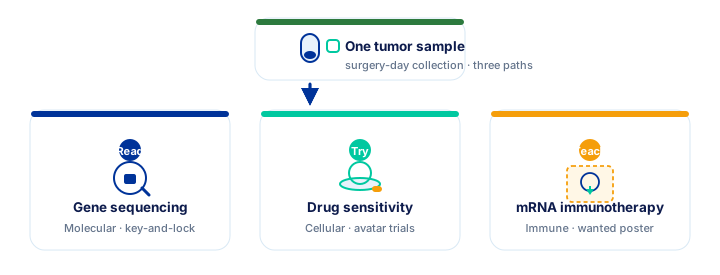
Gene sequencing
Molecular layer: 154-gene panel reads mutations and targets to find drug directions (blocks can be tested later too)
Drug sensitivity testing
Cellular layer: 3D organoid "avatar" tests 48 drugs — a "drug map" in ~10 days
mRNA immunotherapy
Immune layer: RNA-seq plus AI neoantigen analysis to build a "wanted poster" for this dog alone (IIT study)
Read first, then treat — sampling is where this path begins.
Four steps to preserve a sample
Contact the team before surgery
Add us on WeChat petcura, share your surgery plan — confirm the sampling plan; preservation solution delivered in advance
Prepare the dedicated solution
RNA sequencing and drug sensitivity testing need different dedicated preservation solutions — preparation in advance is the key
Properly preserve on surgery day
Tumor tissue plus paired normal tissue, placed into the solution per protocol, kept cold-chain
Ship or store, then decide calmly
Send to the lab for storage; once pathology is back, discuss the route with family and your veterinarian — calmly
Common worry: does sampling stimulate the tumor?
No. Delay is the real danger.
- Canine oncology specialist Dr. Du Hongchao: "The risk of biopsy is minimal — delaying treatment is the greatest danger to your furry child."
- Human-medicine data: among over 10 million biopsies performed worldwide each year, the probability of needle-track tumor seeding is below 0.001%
- "It looks bigger after sampling" is an illusion — the tumor was growing anyway; sampling just made you watch it
Only sampling and diagnosis can define the treatment plan — the earlier the treatment, the wider the time window.
Tumor surgery coming up? Contact PETcura first
Add us on WeChat petcura — prepare the dedicated preservation solution and confirm the sampling plan before the window passes.
Learn more: Pet Parents Decision Map · Gene sequencing · Drug sensitivity testing · mRNA immunotherapy